Have you ever stopped while writing and wondered whether Exception vs. Acception is just a spelling mistake or two different words in English? This is a very common point of confusion, especially for learners who come across similar-looking terms in reading, writing, and everyday communication.
In simple terms, an exception refers to something that does not follow a general rule, pattern, or expectation. For example, when everything is going according to plan but one case is different, that case is called an exception. On the other hand, acception is rarely used in modern English and is often mistaken for “acceptance,” which refers to the act of receiving, agreeing, or approving something.
Even though these words may look similar at first glance, their meanings belong to completely different contexts in English grammar and usage. This confusion often appears in searches like “exception meaning,” “is acception a word,” and “difference between exception and acception,” especially among learners trying to improve their writing accuracy and vocabulary skills.
If you’ve ever hesitated while writing a sentence like “there is one exception to the rule,” you’re not alone—this is one of those tricky word pairs where a small spelling change completely changes meaning or leads to a non-standard form.
In this guide, you’ll learn the clear difference between exception and acception, their correct usage, real-life examples, and simple memory tricks so you can use them confidently in both writing and conversation.
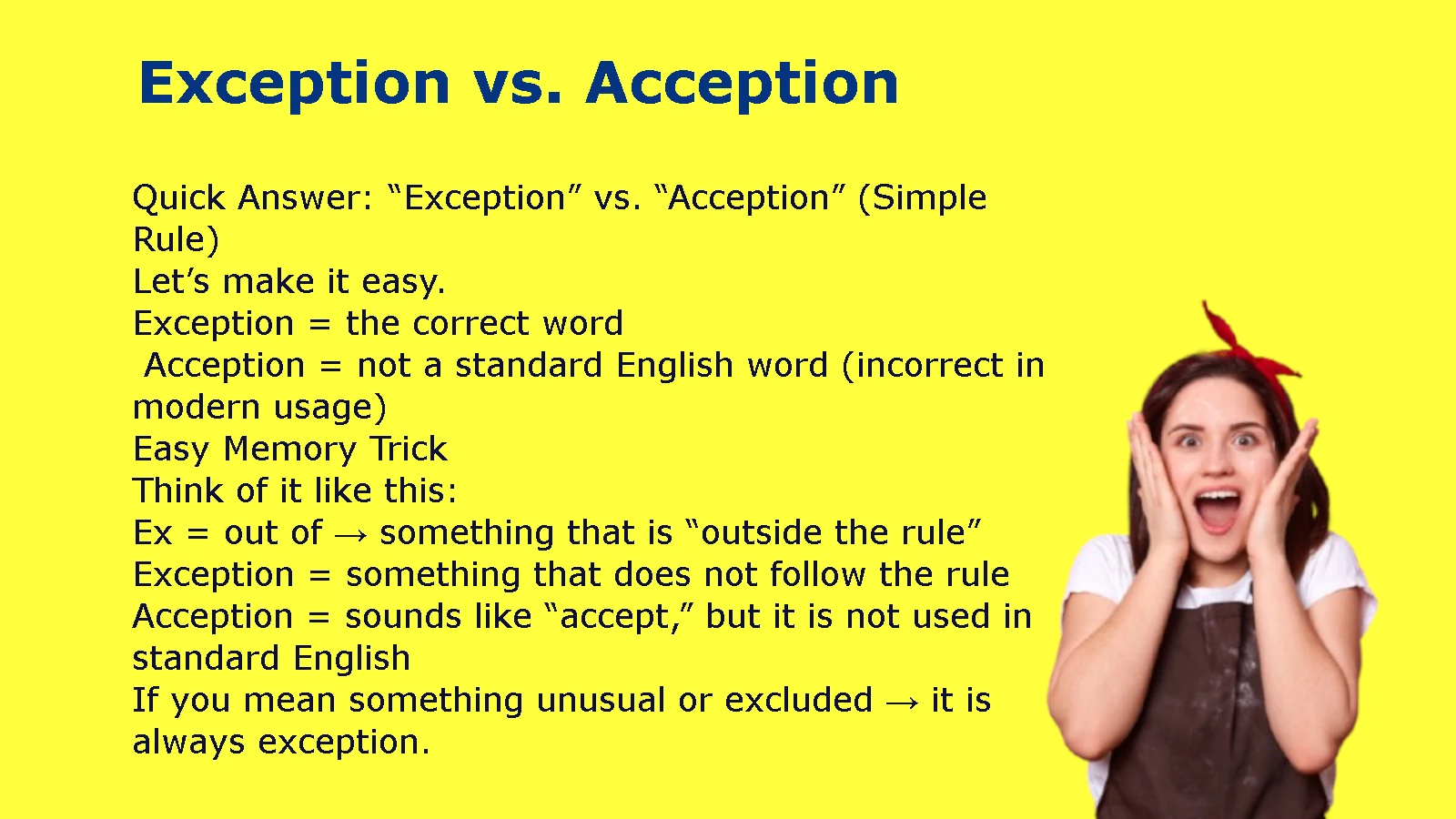
Quick Answer: “Exception” vs. “Acception” (Simple Rule)
Let’s make it easy.
Exception = the correct word
Acception = not a standard English word (incorrect in modern usage)
Easy Memory Trick
Think of it like this:
- Ex = out of → something that is “outside the rule”
- Exception = something that does not follow the rule
- Acception = sounds like “accept,” but it is not used in standard English
If you mean something unusual or excluded → it is always exception.
Why People Get Confused
This confusion happens for a few simple reasons.
Similar Sound
Both words sound almost identical when spoken quickly.
“Accept” Connection
People mistakenly think:
- accept → acception (logical but wrong)
Spelling Trap
English words often have similar endings like:
- perception
- reception
- exception
So “acception” feels like it should exist—but it doesn’t.
What “Exception” Actually Means
Let’s break it down clearly.
Exception = something that is excluded from a rule or does not follow the general pattern
Standard Meaning
- A case that is different from others
- Something not included in a rule or group
Simple Examples
- “Everyone passed the test, with one exception.”
- “This rule has no exceptions.”
- “She is an exception to the usual pattern.”
Key Idea
An exception is something standing outside the rule.
Does “Acception” Exist?
Short answer: No (in modern standard English).
What People Think It Means
Most learners assume it should mean:
- the act of accepting
- acceptance
Correct Word Instead
The correct form is:
- acceptance (not acception)
Example Correction
❌ “His acception into the group was quick.”
✔ “His acceptance into the group was quick.”
Key Insight
If you are tempted to write “acception,” replace it with acceptance.
The Grammar Logic Behind “Exception”
Understanding structure makes it easier to remember.
Word Family
- except → verb/preposition (to leave out)
- exception → noun (something left out)
- exceptional → adjective (unusual or outstanding)
Pattern Breakdown
- ex + cept = to take out
- ex + ception = the result of being taken out
Key Takeaway
“Exception” follows a real word formation pattern in English.
“Exception” in Real-Life Situations
Let’s see how it appears in daily use.
Common Situations
- “No exceptions to the rule.”
- “There is one exception to the policy.”
- “He is an exception to the group.”
Mini Scenario
A teacher says:
“Everyone must submit homework on time—no exceptions.”
Meaning:
Nobody is allowed to break the rule.
Common Mistakes People Make
Here’s where most learners slip.
Mistake 1: Writing “acception”
They assume it exists because it sounds logical.
Mistake 2: Confusing with “acceptance”
They mix noun forms incorrectly.
Mistake 3: Overthinking spelling
They try to “fix” exception into something more familiar.
Side-by-Side Comparison Table
| Word | Meaning | Correct Usage | Status |
| Exception | Something not included in rule | Yes | Correct word |
| Acception | Not standard English | No | Incorrect |
| Acceptance | Act of accepting | Yes | Correct word |
Real-Life Examples of “Exception”
Simple Usage
- “This rule has no exceptions.”
- “She is an exception to the norm.”
- “We made an exception for him.”
Workplace Example
- “No exceptions to the deadline policy.”
Everyday Example
- “I usually don’t eat sweets, but today is an exception.”
Why “Acception” Feels Real (But Isn’t)
English often misleads learners.
Similar Words That Exist
- reception
- perception
- conception
So people assume:
accept → acception (but English doesn’t follow that pattern here)
Key Truth
Not every logical formation exists in English.
How to Never Confuse Them Again
Use these simple rules:
Rule 1
Talking about rules or exclusions → exception
Rule 2
Talking about being accepted → acceptance
Rule 3
If “acception” comes to mind → replace it immediately
What to Say Instead (Correct Alternatives)
Instead of wrong usage, use:
- “exception” → for rule-breaking cases
- “acceptance” → for approval or admission
Better Phrases
- “with one exception”
- “no exceptions allowed”
- “acceptance into the program”
Quick Decision Guide
Use this instantly:
- Rule broken → exception
- Approval given → acceptance
- Unsure → check meaning, not spelling guess
FAQ: “Exception” vs. “Acception”
Is “acception” a real word?
No, it is not used in standard modern English.
What is the correct word for “acception”?
Usually acceptance.
Why do people write “acception”?
Because it sounds similar to other English noun forms.
Can I ever use “acception”?
No, it is considered incorrect in formal and informal writing.
Key Facts You Should Remember
- “Exception” is the correct word
- “Acception” is not standard English
- “Acceptance” is the correct noun from “accept”
- Context always matters more than guesswork
Final Takeaway: The One Rule That Never Fails
Here’s the simplest truth.
If you are talking about something that breaks a rule or is excluded, always use exception.
If you are talking about approval or being accepted, use acceptance.
And if you ever think of “acception,” just replace it immediately—it does not belong in modern English.
Because when it comes to **“Exception vs. Acception,” clarity is not optional. It is essential.