Have you ever paused while writing and wondered whether “Skies vs. Skys” is a spelling variation or a real grammatical choice in English? This is a surprisingly common confusion among learners because both forms look almost identical, yet only one is correct in standard English usage.
In simple terms, “Skies” is the correct plural form of sky, used to describe the atmosphere above us, weather conditions, or poetic expressions like blue skies, stormy skies, or clear skies ahead. On the other hand, “Skys” is not accepted in standard English and is considered a spelling mistake, often made by learners who try to apply regular plural rules without knowing the exception.
This confusion frequently appears in searches such as skies meaning, skys meaning, difference between skies and skys, and how to spell sky in plural form, especially among students improving their grammar, writing accuracy, and vocabulary skills. It also connects with broader English challenges like irregular plurals, spelling rules, and commonly misspelled words.
If you’ve ever written a sentence like “the skys are blue,” you’re not alone—this is a classic spelling trap in English where a single letter completely determines correctness. In this guide, you’ll learn the correct usage of Skies, why Skys is incorrect, and easy memory tricks to avoid this mistake forever.
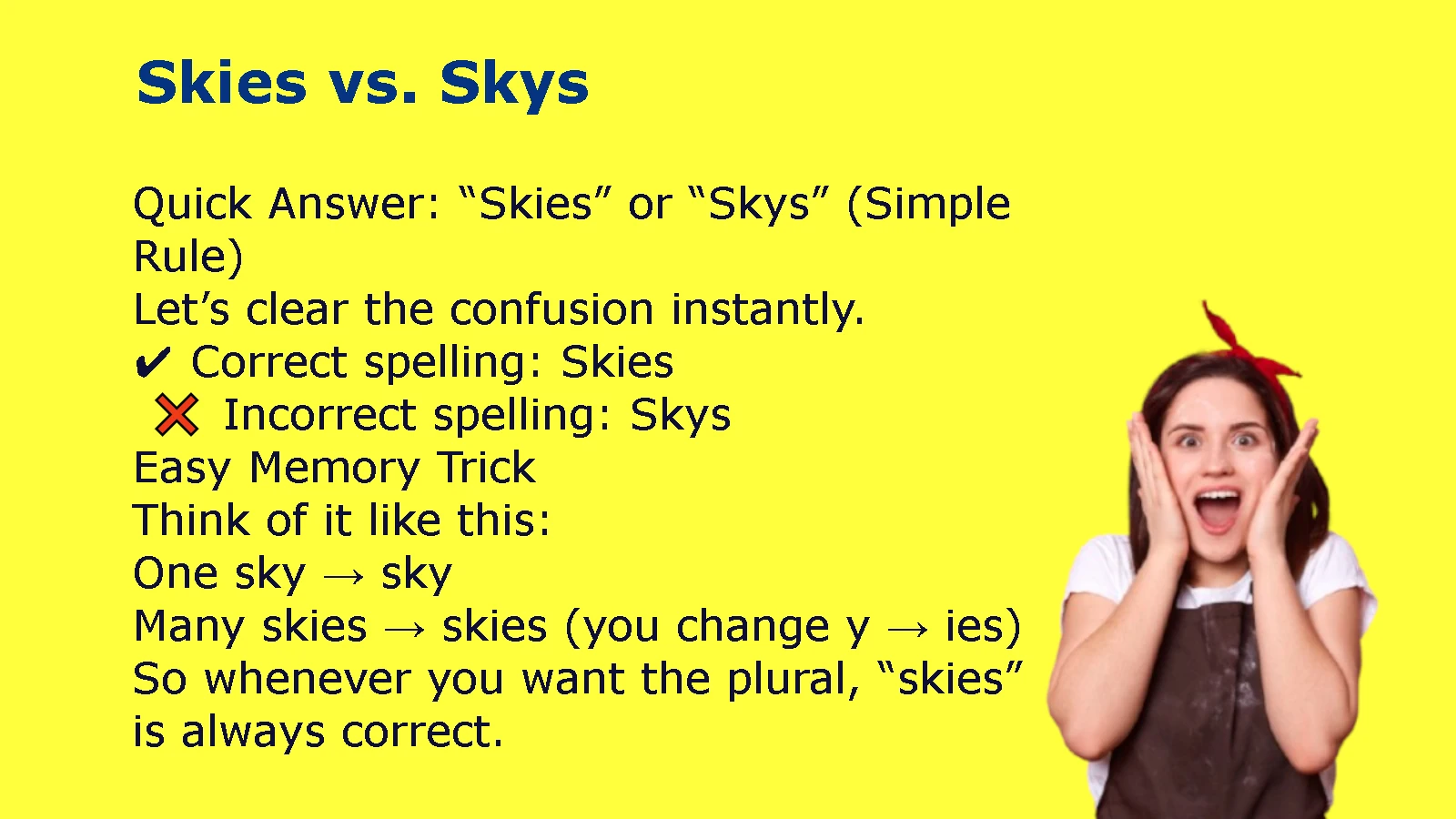
Quick Answer: “Skies” or “Skys” (Simple Rule)
Let’s clear the confusion instantly.
✔ Correct spelling: Skies
❌ Incorrect spelling: Skys
Easy Memory Trick
Think of it like this:
- One sky → sky
- Many skies → skies (you change y → ies)
So whenever you want the plural, “skies” is always correct.
Why “Skies” Is Correct (Simple Grammar Logic)
The word “sky” ends in a consonant + “y”. In English grammar, when you make such words plural, you don’t just add “s”.
Instead, you follow a pattern:
👉 Change “y” → “ies”
So:
- sky → skies
- baby → babies
- city → cities
This rule keeps pronunciation smooth and consistent.
Key Insight
English avoids awkward plurals like “skys” because they are harder to pronounce and break standard spelling patterns.
Why “Skys” Is Wrong (Common Mistake Explained)
At first glance, “skys” might feel logical. After all, we usually add “s” to make plurals, right?
But here’s the issue:
What goes wrong
- People apply the simple “just add s” rule
- They ignore words ending in “y”
- Result: incorrect spelling like “skys”
Why it feels confusing
English has multiple plural rules:
- cat → cats (simple)
- sky → skies (y → ies rule)
That mix creates confusion, especially for learners.
“Skies” in Everyday Use (Real Examples)
Let’s see how it appears in natural sentences.
Common Usage
- The skies turned dark before the storm.
- We looked up at the clear blue skies.
- Birds were flying across different skies.
What it means
“Skies” is often used in two ways:
- Literal meaning → the atmosphere above us
- Poetic meaning → emotional or descriptive writing
Singular vs Plural: Sky vs Skies
Here’s a simple breakdown:
| Word | Meaning | Example |
| Sky | One atmosphere above | The sky is blue |
| Skies | Multiple or poetic usage | The skies are cloudy |
Key Insight
Even though there is only one physical sky, English uses “skies” for:
- poetic expression
- weather descriptions in different regions
- literary writing
When Do We Use “Skies”?
You’ll mostly see “skies” in these situations:
1. Weather Descriptions
- The skies are clear today.
- Dark skies signal rain.
2. Poetic Language
- Under open skies, we found peace.
- She dreamed of endless skies.
3. Regional or Imagined Views
- The skies over different countries looked the same.
Why People Confuse “Skies” and “Skys”
This mistake usually happens because of three reasons:
1. Overgeneralizing Plural Rules
People assume every word just gets “s”.
2. Typing Habit
Fast typing leads to skipping grammar rules.
3. Lack of Exposure
Many learners don’t see enough correct written examples.
Quick Comparison Table
| Word | Correct? | Rule | Example |
| Skies | ✔ Yes | y → ies | The skies are blue |
| Skys | ❌ No | Incorrect form | ✘ Not used in English |
Real-Life Mistake Example
Situation:
A student writes:
The skys were full of stars last night.
Problem:
The spelling is incorrect.
Correct Version:
The skies were full of stars last night.
Lesson:
A small spelling change makes writing look more natural and professional.
Simple Trick to Never Get It Wrong
Use this fast rule:
👉 If a word ends in consonant + y, change y → ies
So:
- sky → skies
- fly → flies
- try → tries
Quick Memory Hook
“Drop the Y, bring the IES.”
FAQ: Skies or Skys
Is “skys” ever correct?
No. “Skys” is always incorrect in standard English.
Why do people write “skys”?
Because they apply the regular “add s” rule without checking spelling rules.
Is “skies” singular or plural?
It is the plural form of “sky,” though often used poetically even for one sky.
Can I use “skies” in formal writing?
Yes, it is completely correct and commonly used.
Key Facts to Remember
- ✔ Correct spelling: Skies
- ❌ Incorrect spelling: Skys
- Rule: y → ies for plural
- Common in weather and poetic writing
- “Skys” is never used in standard English
Final Takeaway: The One Rule That Solves It All
The confusion between “skies” or “skys” disappears the moment you remember one simple rule:
👉 Words ending in consonant + “y” change to “ies” in plural form.
So instead of guessing, just rely on the pattern. English becomes much easier when you stop memorizing mistakes and start recognizing rules.
Because in the end, it’s not just about spelling—it’s about writing clearly, confidently, and correctly every single time.